Glastonbury Co-operative Fair celebrates ‘This Beautiful Idea’
- June 2026
Manchester City Council aims to measure residents’ quality of life to develop more effective policies.

Manchester has experienced significant economic growth over the past 20 years; however, many residents are disproportionately affected by poverty and poor health. Recognising this, Manchester City Council (MCC) aims to measure residents’ quality of life to develop more effective policies.
The University of Manchester (UoM) worked with residents in North Manchester to explore what they valued most for their well-being. As a consequence of this work, MCC joined the UN-Habitat Quality of Life Initiative (QoLI). UN-Habitat, the United Nations agency responsible for promoting sustainable urban development, developed the initiative with input from a broad group of academic advisers. The framework is designed to measure well-being in urban areas. Manchester is the first UK city to participate in the programme.
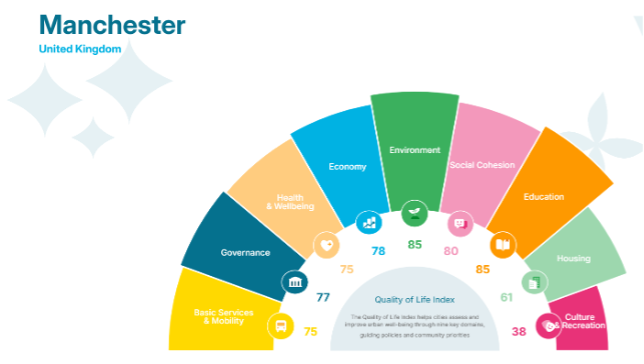
The QoLI requires the collection of a set of “global indicators” across nine thematic areas, closely aligned with the UN’s Sustainable Development Goals (SDGs). The framework combines both quantitative indicators and qualitative measures to present a more comprehensive view of well-being.
Each city was also able to develop a set of local indicators relevant to its own priorities and local context. This followed a facilitated workshop that identified local priorities and how to translate them into meaningful measures. These form the city’s QoLI, which is presented visually to highlight areas of strength.
Peter Norris
Strategy and Economic Policy Manager
Manchester City Council